Metrology
Computational Imaging

About
Is it possible to use relatively simple optics to make fast, high-quality images for metrology applications with sub-nanometer precision? This is the main challenge the Computational Imaging research group at ARCNL and VU Amsterdam tries to tackle.
Research focus
Our research explores high-precision metrology techniques that balance size and cost by combining simple optical setups with advanced algorithmic computation.
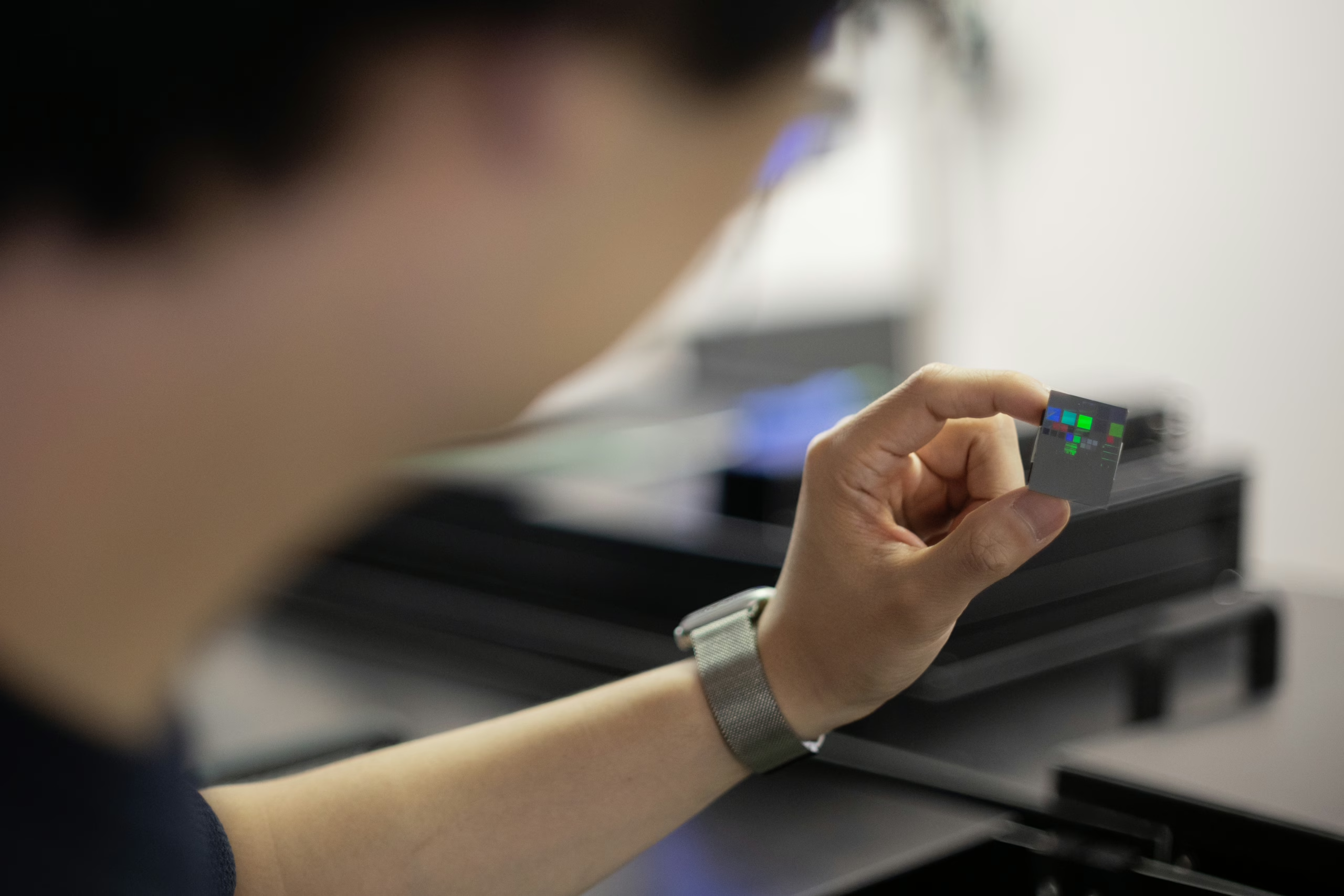
Computer chips consist of many different structured layers. The chip performance is largely defined by the quality of patterning steps like lithography and etch. Chip manufacturers use optical metrology techniques to measure and control the quality of these patterning steps to sub-nanometer levels. As the patterns continue to get smaller, the quality of the optical metrology also needs to improve. This results in complex optics that need to be of the best possible quality. As a result, optical metrology becomes expensive, and the industry needs a solution to keep the metrology cost acceptable.
Computational imaging aims to improve optical metrology without the use of expensive complex optics. In this approach, the metrology sensor uses relatively simple optics resulting in imperfect images. Smart algorithms are used to correct these image imperfections yielding the near-perfect image quality that metrology needs. The research is focused on answering questions like: Which measurement configuration should be used? Which algorithms are sufficiently accurate and fast enough? What are the best possible light sources? And what signal-to-noise ratio is needed to obtain good quality images?
Since this technology has implications for all areas where it is useful to improve imaging quality, the group closely cooperates with other groups like the Biophotonics and Medical Imaging group at VU Amsterdam.
Group members
Arie den Boef is an ASML Corporate Fellow and leads the Computational Imaging group at ARCNL and VU Amsterdam, where he is an Endowed Professor.




Latest news




Most recent publications