EFISH in liquids
One of the areas of research in the Light-Matter Interaction group is EFISH, but it has nothing to do with fish. It stands for “electric field-induced second harmonic generation,” a technique which can be used to study electric fields and by extension, how electric charges move in materials, by measuring the second-harmonic laser light the process generates.
While EFISH itself is not new, researchers in the group are exploring how the technique can be applied in liquids. When water flows over a surface, for example in pipes, this loosens electrons in the material, creating electric fields in the water. Being able to measure these electric fields could provide new ways to study, for example, the purity of a liquid, as contaminants could alter the electric field and therefore the light from EFISH.
Though not a primary research objective of the group, EFISH in liquids was an idea that group leader Professor Paul Planken thought could be useful to support other research in the group. They decided to bring on University of Amsterdam MSc student Victor Szacillo as an intern for six weeks to explore the possibilities.
Olive oil experiments
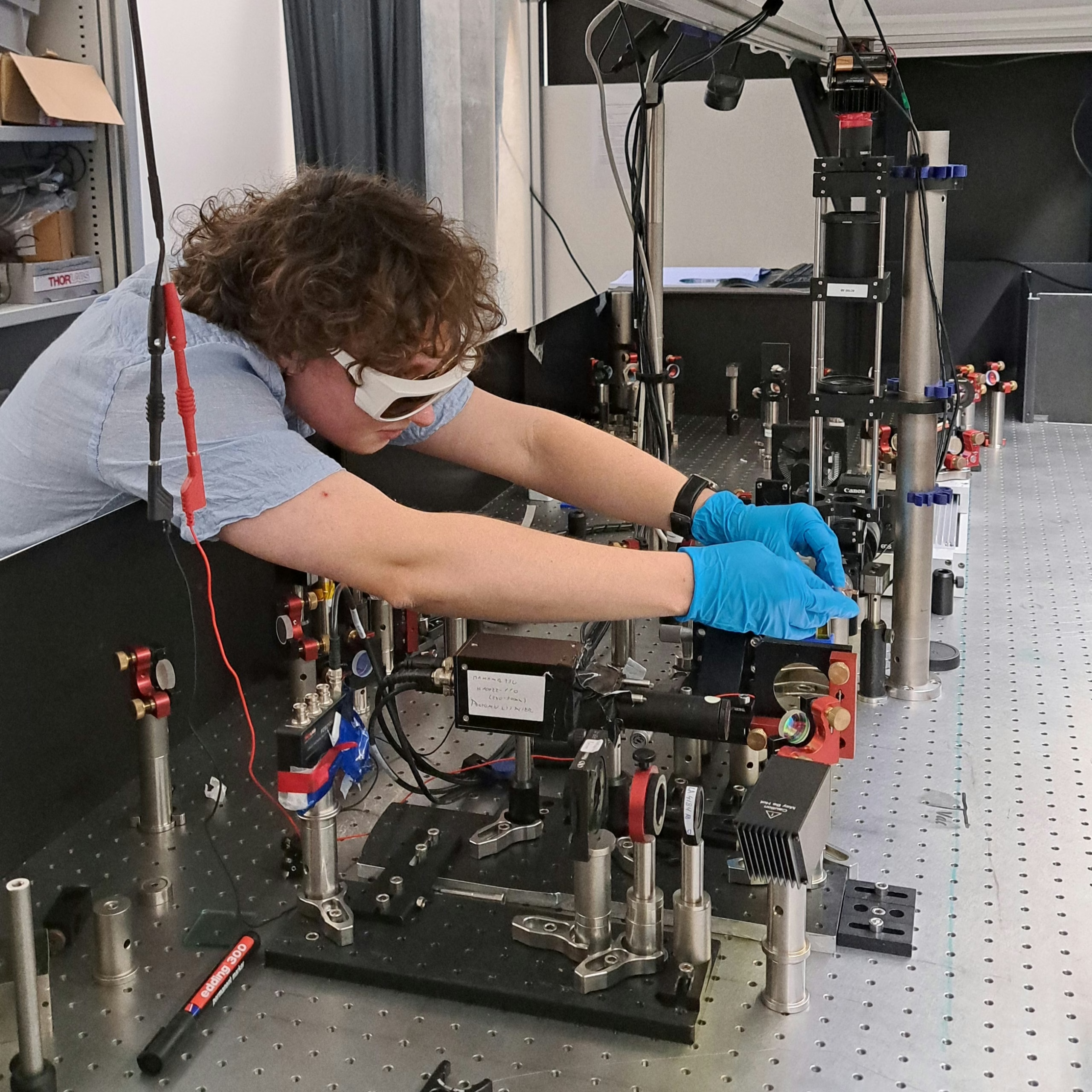
The original idea for Victor’s project was to explore EFISH in water. He designed new holders for the liquid and electrodes to implement in the existing lab setup. However, he quickly learned that water’s conductivity may actually make it a poor candidate for EFISH measurements. “We realized deionized water doesn’t stay deionized in the lab. The water starts conducting so we got an electric current,” explains Tom, who supervised Victor’s project.
After considering all safety concerns, Victor and Tom decided to try another liquid: extra-virgin olive oil. “We found a paper that discusses its light absorption spectrum, and saw that it could make olive oil suitable for transmitting the second harmonic light,” shares Victor.
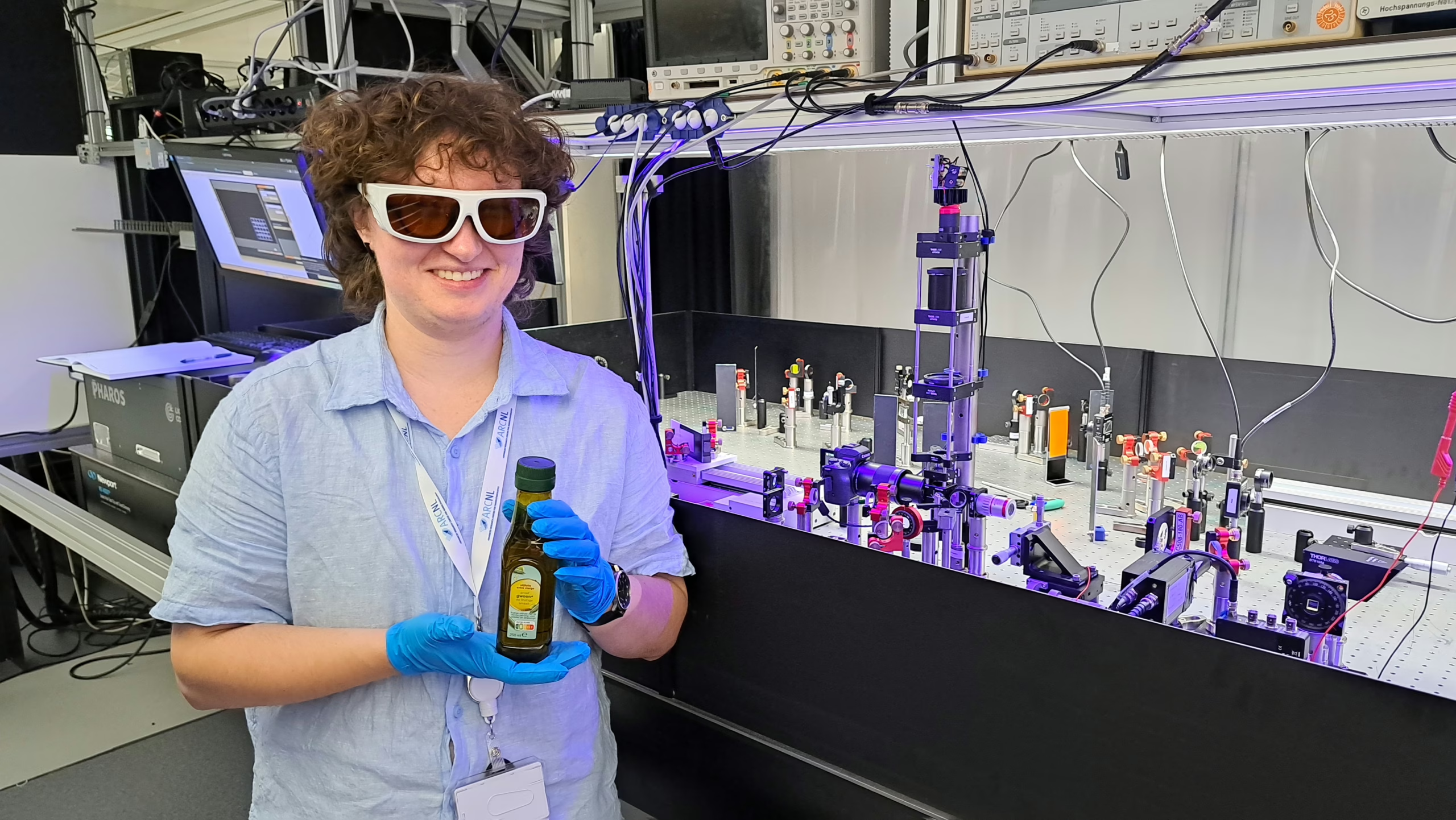
This new direction for Victor’s project added another layer to his internship experience. “It felt funny to buy a bottle of olive oil for a lab experiment,” says Victor, “but at the same time, it’s awesome that something you can also find in the grocery store can be used for real science.”
Opportunities for student projects
While Victor was ultimately able to get the experimental setup to work, he and Tom didn’t see any conclusive results. For now, the group will continue to focus on EFISH measurements in semiconductor materials rather than liquids. “Other things are more pressing for now, but thanks to Victor we know that we are able to measure an EFISH signal in a liquid, so this could be useful for future projects,” says Tom.
Victor’s project also highlights the opportunities for student interns to do research projects at ARCNL. “It’s really nice that ARCNL has the flexibility to accommodate a student for just a short time,” says Tom. “He got to be in the lab and do some fun science.”
Interested in doing your own project at ARCNL? Explore opportunities on our Careers page.
Contact
For more information about this research project, please contact Paul Planken (P.Planken@arcnl.nl).