Metrology
High-Harmonic Generation and EUV Science

About
The High-Harmonic Generation & EUV Science group develops and uses coherent extreme-ultraviolet (EUV) and soft-X-ray light created through high-harmonic generation. Their work enables advanced imaging and spectroscopy with extremely high time resolution and nanometer-scale precision.
Research focus
The group advances both the understanding and the practical use of high-harmonic generation (HHG). We explore different materials for generating EUV and soft-X-ray light and develop new approaches for imaging and measuring matter on ultrafast timescales and very small length scales.
The group develops HHG sources in gases as well as in solids, including semiconductors, strongly correlated materials, nanostructures, and metasurfaces. In solids, we investigate ways to enhance conversion efficiency using multi-color laser driving or non-collinear wave-mixing. These methods aim to create powerful and coherent tabletop EUV sources.
We also work on EUV interferometry, which relies on precisely controlling the emission from solid-state HHG. This can provide high temporal and spectral resolution suited for applications such as imaging, holography, and material-specific spectroscopic studies.
Using HHG-generated EUV light from noble gases, the group performs scatterometry at shallow (grazing) angles to reconstruct the surface shape of periodic nanostructures without damaging them. By combining this approach with pump-probe techniques, where one pulse excites a material and another probe pulse measures the response, we can monitor ultrafast changes in electronic structure or lattice arrangement. This allows us to follow processes such as the transition from an insulator to a metal in real time.
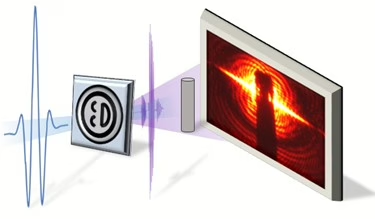
The group has introduced a new microscopy method called Harmonic Deactivation Microscopy (HADES). The technique uses HHG within a micrometer-scale volume and shapes the light with a second, donut-shaped beam to suppress emission in specific regions. This allows spatial resolution beyond the diffraction limit without relying on fluorescent labels that alter a sample. HADES opens the door to studying solid-state materials at the nanoscale with femtosecond time resolution, offering new opportunities for semiconductor research and materials science.
Another research line explores how to control HHG in solids using light alone, for example by selectively suppressing certain harmonics. This can provide insight into material properties such as band structure and may enable new imaging methods for semiconductor materials. The physical mechanisms behind harmonic suppression are still not fully understood, and the group aims to clarify these microscopic processes.
Strongly correlated materials exhibit rich and often non-equilibrium behavior when driven far from equilibrium, including ultrafast insulator–metal transitions, hidden phases, and transient electronic orders that exist only for tens to hundreds of femtoseconds. The group develops metrology techniques based on nonlinear light generation and short-wavelength sources to directly access these short-lived states with simultaneous temporal and structural sensitivity. This approach enables the identification and control of emergent phases in materials such as transition-metal oxides and layered systems, with potential applications in ultrafast electronics and quantum materials research, possibly extending the semiconductor roadmaps beyond silicon.
Group members
Peter Kraus, Associate Professor of Physics at VU Amsterdam, leads the group. He is also head of the Metrology Department at ARCNL. His background is in attosecond science and high-harmonic spectroscopy, which he uses to explore ultrafast electronic and nuclear dynamics and to develop new EUV light sources and metrology techniques.













Latest news



Most recent publications