Linking multiple disciplines
In the latest nanolithography machines, tin plasmas are the source of EUV light. This design choice, at the time, optimized the balance between intense short-wavelength light and high mirror reflectivity.
Dr. John Sheil, leader of the Plasma Theory and Modeling group at ARCNL and assistant professor at Vrije Universiteit Amsterdam, wants to take the next step towards being able to use even smaller wavelengths of light for nanolithography.
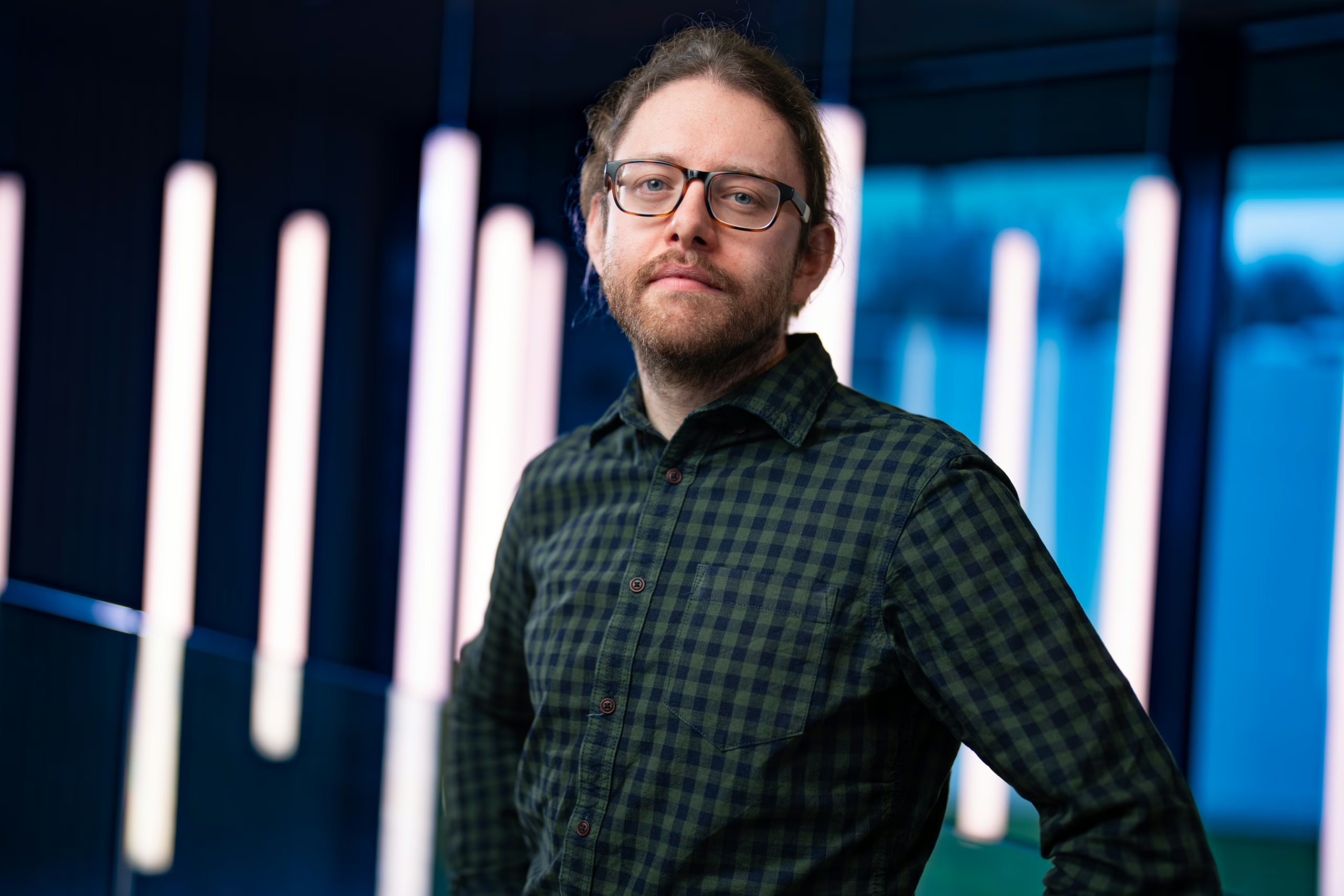
His NEXUS project, funded by an ERC Starting Grant, aims to develop models to predict the behavior of complex ions in soft X-ray emitting laser-plasmas.
“The word ‘nexus’ in English means a link, or connection,” says John. “In this project, I will build a nexus between three disciplines to solve an outstanding problem in plasma physics.”
Why no soft X-rays (yet)?
To be able to use even shorter wavelengths of light, such as soft X-rays, to print smaller features on computer chips, you need to explore plasmas from other elements.
However, mirrors that have been developed to reflect soft X-rays have extremely small bandwidths. This means that the light source should generate lots of soft X-ray power in a narrow bandwidth.
This challenge involves making very accurate calculations of the energy and intensity of soft X-ray radiation emitted by complex ions, much higher precision than is generally needed for plasma-radiation sources.
“Predicting the radiative properties of these plasmas requires understanding how atoms behave in very hot environments, which is an exciting challenge.”
Plasma models play a key role in understanding and predicting the outcomes of experiments, and can guide such activities in identifying the optimum parameters that optimize source performance.
John’s NEXUS project aims to develop such models. “I’m confident we can pull it off, but it won’t be easy!” says John.

Industry-driven fundamental research
The need for more precise atomic and plasma models, coming from constraints set by current technological capabilities, is part of what makes John excited to pursue this project.
“The semiconductor industry needs fundamental physics to be better understood,” says John. “I think it’s beautiful that our pursuit of this fundamental knowledge can address real-world problems.”
Contact
If you have questions about this project, please contact John Sheil (J.Sheil@arcnl.nl).